


Perceptions about private label (store brands) are overwhelmingly favourable—almost three-quarters of Egypt respondents (73%) say store-brand quality has improved over time, according to a new study by Nielsen, a leading global provider of information and insights into what consumers watch and buy. Despite that fact, Egypt’s private label development is still in its infancy, representing just over 0% of annual dollar sales.
The Nielsen Global Survey of Private Label polled more than 30,000 Internet respondents in 60 countries to understand how consumer perceptions about private label quality, value, assortment and packaging translate into sales around the world.
“Brands will continue to dominate in Africa/Middle East for the near future,” said Onur Yuksel, retail services leader for Nielsen Middle East, North Africa and Pakistan. “Private label growth is heavily dependent on the spread of modern trade, which has relatively low penetration throughout the region and is primarily available in urban areas only. Future development will be largely dependent on how retailers monitor the performance of new launches and use that information to develop the right products at the right price.”
While price is the primary driver of consumers’ purchase intent, the appeal of the label needs to go a step further. Consumers are seeking quality and value, and for a private label to be successful it must deliver on both of these attributes.
- Advertisement -
In Egypt, almost half of the respondents (48%) felt that store brands (or private labels) are not suitable for products when quality matters. Thirty-three percent showed a neutral sentiment when it came to perception of quality of private labels.
There is hope, however, for private-label producers in the fact that while shopping 70% of the respondents admitted to compare prices between their preferred brands and private label products. Moreover 54% of respondents are willing to pay the same or more for a store brand, but on the condition that they like it. Poor quality perceptions and strong brand loyalty can pose significant barriers to private label growth.
ABOUT THE NIELSEN GLOBAL SURVEY
The Nielsen Global Survey of Private Label was conducted between Feb. 17 and March 7, 2014, and polled more than 30,000 consumers in 60 countries throughout Asia-Pacific, Europe, Latin America, the Middle East, Africa and North America. The sample has quotas based on age and sex for each country based on its Internet users and is weighted to be representative of Internet consumers. It has a margin of error of ±0.6 %. This Nielsen survey is based only on the behavior of respondents with online access. Internet penetration rates vary by country. Nielsen uses a minimum reporting standard of 60 %Internet penetration or an online population of 10 million for survey inclusion. The Nielsen Global Survey, which includes the Global Consumer Confidence Index, was established in 2005.
[i] While an online survey methodology allows for tremendous scale and global reach, it provides a perspective on the habits of existing Internet users, not total populations. In developing markets where online penetration is still growing, audiences may be younger and more affluent than the general population. In addition, survey responses are based on claimed behavior, rather than actual metered data.
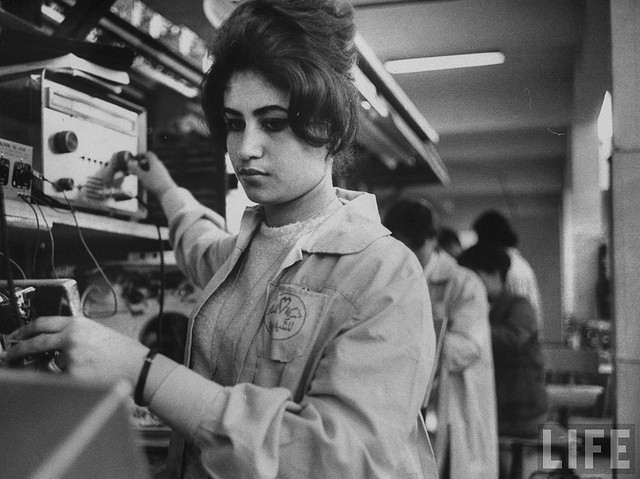
In the photo Egyptian Woman working in the TeleMisr factory in 1960s